
Why Your AI-Generated Brand Sounds Like Everyone Else's (And What's Actually Missing)
Most wellness entrepreneurs are prompting AI like it can read their mind. Here's the layer you're skipping, and why nothing will sound like you until you build it.

I watched someone in my industry sit down and prompt AI last week, and I had to stop myself from saying something out loud.
She typed something like “write me a social media post for my wellness business.” Hit enter. Waited ten seconds. Copied it. Pasted it. Posted it.
And I sat there thinking, are you kidding me? That’s it? That’s what you’re giving it to work with?
Here’s the thing nobody wants to hear. That post wasn’t bad because AI is bad at this. It was bad because she gave it absolutely nothing to work with, and then acted shocked when it sounded like it could belong to literally any wellness coach on the internet. Because it could. That’s exactly what it was built from.
I’m not telling you this to make you feel stupid. I’m telling you because I think about ninety percent of wellness entrepreneurs are doing some version of the exact same thing, and every single one of them is walking away thinking “I guess AI just doesn’t work for me” or “I guess my brand voice can’t be captured by a machine.” Babe. That’s not what’s happening here.
I actually think it’s kind of funny, watching this happen from the outside, because I know for a fact this same woman would never walk into a photo shoot without telling the photographer what vibe she wanted. She’d never hire a designer and just say “make me a logo” with zero direction and expect it to somehow land exactly right. She knows, in every other part of her business, that vague direction gets vague results. But the second AI enters the chat, all of that instinct goes out the window, because somewhere along the way we decided AI is different. That it’s supposed to just know.
The Myth You’ve Been Sold
Somewhere along the way, we all got told that AI is basically magic. You type a sentence, it reads your mind, and out comes a perfectly branded, completely-you piece of content. Like it’s supposed to know you were a nurse for twelve years before you became a nutritionist. Like it’s supposed to know you curse when you’re passionate and never use the word “journey” because it makes you want to gag. Like it’s supposed to know your entire philosophy on wellness without you ever telling it.
It can’t. Not because it’s not smart enough. Because you never gave it the material.
I actually think AI is unbelievably good right now. When people show me content that “sounds like AI,” half the time I genuinely can’t tell the difference, and I think that says less about AI and more about how good the prompting was. Good input gives you good output. Vague input gives you garbage. There’s no version of this equation where you skip the strategy and still get something that sounds unmistakably you.
And that’s the actual myth. It’s not “AI can’t do branding.” It’s “AI can do branding without me doing any of the strategic work first.” That one’s false. That one’s always going to be false, no matter how advanced these tools get, because the strategy isn’t something AI is supposed to invent for you. It’s something only you can hand over.
The Prompt That’s Still Killing You
Let’s actually look at the prompt for a second, because I think most people don’t realize how much they’re leaving out.
“Write me a social media post for my wellness business.” That’s the whole thing. No context on what the post is about. No mention of who it’s for. No hint of tone, voice, or philosophy. Nothing about what makes this business different from the thousand other wellness businesses AI has been trained on. You’ve given it a job description with no job details, and then you’re disappointed when it hires the most average candidate possible.
Now picture the same request, but with actual input behind it. “I need a caption for a post about why I stopped recommending restrictive meal plans to my clients. I’m direct, a little blunt, I curse when I’m passionate about something, and I never use the word journey. My audience is burnt out women in their 30s and 40s who have tried every diet and are exhausted by all of it. I want this to feel like I’m calling out the diet industry a little, not preachy, more like I’m venting to a friend.” That’s not a longer prompt for the sake of being longer. That’s the actual material AI needs to give you something that sounds like a person instead of a placeholder.
Notice neither example took ten minutes to write. The second one just took actual thought instead of zero thought. That’s the whole gap.
The Layer Everyone Skips
So what’s actually missing? It’s the same thing that’s been missing this entire time, long before AI ever showed up. It’s strategy.
I’m talking about the stuff that makes you different from every other wellness coach doing the exact same thing you do. Your philosophy. Why you do this work the way you do it and not the way everyone else does. The specific way you talk when nobody’s editing you. Who you’re actually trying to reach, in real, specific, un-vague language, not “women who want to feel their best,” which could describe every human alive.
When you skip that and go straight to “write me a bio,” you’re not asking AI to write in your voice. You’re asking it to invent a voice from scratch and guess. And it will guess. It’ll give you something polished, professional, technically correct, and completely forgettable. Because it’s pulling from the entire internet’s version of a wellness coach bio, not from you.
This is the exact same problem I’ve been talking about with brands for twenty years, just wearing a new outfit. Pretty without strategy is decoration. AI content without strategy is the same decoration, just faster to produce. You haven’t fixed the actual problem. You’ve just sped up the process of getting a generic result.
What “Training Your AI” Actually Means
Here’s where it gets good, because once you understand this, everything changes.
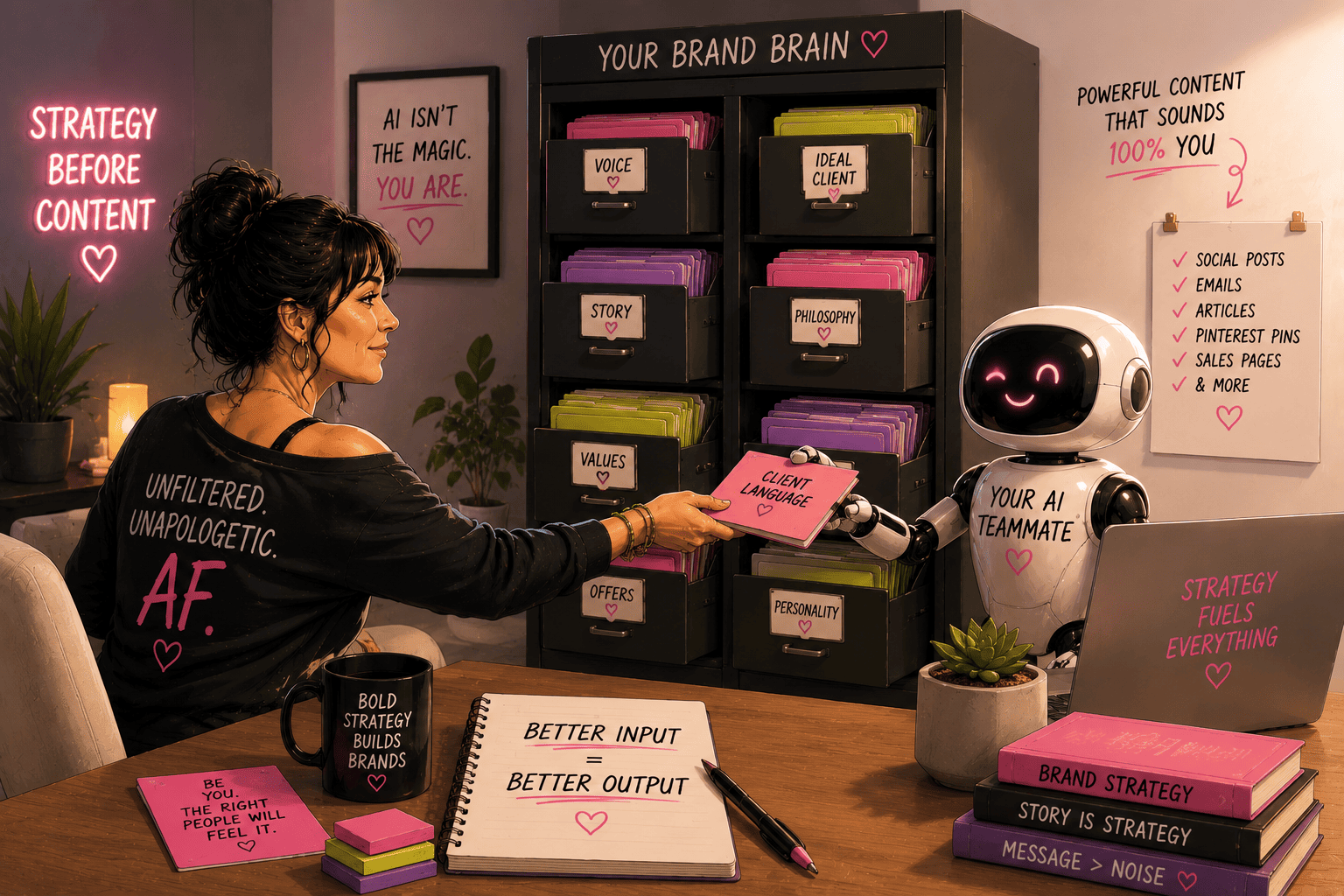
You have to train your AI the same way you’d train a new hire. Think about it. If you brought on a virtual assistant tomorrow and handed her zero information about your business, your voice, your clients, or your philosophy, and then asked her to write your next newsletter, you’d get something generic back too. Not because she’s bad at her job. Because you never onboarded her.
AI is no different. It needs the onboarding. It needs to know why you’re different, what you believe, how you talk, who you’re talking to, and what you absolutely will not sound like. And the more you give it, the more it starts to actually sound like you instead of sounding like “wellness coach, generic version.”
I do this constantly. I talk to my AI the way I’d talk to a coworker I actually trust with something important. I explain what I’m looking for in detail. I give context. If there are parameters, I say them. I don’t type four words and expect it to fill in the other five hundred correctly, because that’s not how any working relationship functions, human or otherwise.
And here’s the part almost nobody does. When I take something AI gave me and rewrite it, I don’t just walk away with my edited version and never look back. I drop the edit back into the conversation and tell it exactly what I changed and why. “Hey, you gave me this, I edited it to sound more like me, here’s the difference, you don’t need to do anything with it, just take note.” Over time, it starts to pick up on my slang. My cursing. The way I structure a thought. It’s not static. It’s learning, the same way any person would if you kept giving them feedback instead of just correcting their work in silence and hoping they’d figure it out.
That feedback loop is the entire game. Most people prompt once, get an answer, and either use it or give up on AI completely. Neither of those builds anything. The people getting content that actually sounds like them are the ones treating this like an ongoing relationship, not a vending machine.
Building the System, Not Just the One-Off Prompt
Once you’ve trained your AI with the foundational stuff, the next level is building an actual system so you’re not reinventing the wheel every single time you sit down to create something.
This is where a lot of wellness entrepreneurs are leaving so much time on the table. You shouldn’t have to think through your entire content structure from scratch every time you write a Note or an email or an article. Once your AI understands your voice, your business, and your process, you can build out exactly how you want specific types of content to be shaped, every single time, so it follows the same system instead of you reinventing your own wheel every week.
That’s the difference between “I need help writing something” and “take everything you know about my business and give me this in the exact format I’ve already trained you on.” One of those takes real brainpower every time. The other takes almost none, because you already did the thinking once and built it into the system.
This is also why consistency stops feeling impossible once you’ve done this work. You’re not accidentally sounding like five different people across five different pieces of content. You built one system, trained on one voice, and now everything that comes out of it is woven from the same thread.
I actually have separate systems built out for different parts of my content. One that knows exactly how I want my Substack Notes structured, what types of Notes I need across a week, what arcs I use so I’m not reinventing that wheel every time. One that knows exactly how I want an article to be built, from the interview process all the way through to the headline and the footer. One for Instagram. I’m even planning one for Pinterest eventually, and I’m not talking about graphics, just the writing side of it.
The reason this matters is I’m not sitting there every single week trying to remember “okay, how many types of Notes am I supposed to have, what’s the ratio, did I already do a story Note this week.” I already trained the system on that once. Now I just hand it my raw information and tell it to run it through the format it already knows, and it does. That’s the entire difference between doing the strategic thinking every single time versus doing it once and building something that holds onto it for you.
Why the Back-and-Forth Is Actually Faster
I want to address something directly, because I know exactly what some of you are thinking. If I have to go back and forth with AI multiple times before I’m happy with something, isn’t that slower than just typing a prompt once and moving on?
No. And here’s why.
Compare it to starting from a completely blank page. No prompt, no draft, nothing. Just you and a blinking cursor, trying to write a caption or a bio or an email from zero while also second-guessing every sentence. That takes forever, and it’s exhausting in a completely different way, because you’re doing all the creative heavy lifting alone.
Going back and forth with AI that already understands your business, even if it takes four or five rounds to land exactly where you want, is still faster than that blank page every time. And you end up with something that actually fits your brand instead of something that technically works but doesn’t feel like you when you read it back.
I start almost everything I write, including the article you’re reading right now, as a voice memo. I talk it out first, because trying to write the way I talk usually gets jumbled the second I sit down at a keyboard. Then it goes through drafting, editing, and proofing. That process isn’t slower because there are more steps. It’s faster because every step is doing real work, instead of me staring at a cursor hoping the right words show up on their own.
And this is where I think a lot of people psych themselves out of using AI well. There’s this idea floating around that if you’re “good at AI,” it should just work on the first try, every time, in ten seconds flat. That’s not real for anyone. Not for me, not for anyone I know who’s genuinely good at this. What actually happens is I get a first draft, I tell it what’s off, I get a second draft, I tell it what’s still off, and by round three or four we’ve usually landed somewhere I’m proud of. That’s not a failure of the tool. That’s just what creating something good actually looks like, whether a machine is involved or not. Nobody expects their first sentence on a blank page to be perfect either.
This Isn’t Your Fault, But It Is Your Move Now
I want to say this part clearly, because I don’t want you walking away from this feeling like you’ve been doing everything wrong your whole business life.
AI is new. Genuinely new. Nobody has twenty years of experience prompting AI, because it hasn’t existed for twenty years. We are all figuring this out in real time, learning from each other, making mistakes, adjusting. If you’ve been typing vague prompts and getting generic results, that’s not a personal failure. That’s what happens when a brand new tool shows up and nobody hands you the manual.
But here’s where I do want you a little fired up. Now you know. You know that the problem was never the tool. You know the fix isn’t “give up on AI” or “just accept generic content forever.” The fix is building the foundation, training your AI the way you’d train a person you trust, and giving it the raw material to actually sound like you instead of sounding like every other wellness brand pulling from the same generic well.
That’s not a tech problem. That’s a strategy problem, and strategy has always been where I live.
I also want to be honest about something else. Even after you’ve done all of this, even after you’ve trained your AI and built your systems, generic prompts will still give you generic output. I say this from experience, because I’ve trained mine extensively and I still get flat, forgettable results the second I get lazy and type something quick without context. Training your AI isn’t a one-time fix that means you never have to think again. It raises the floor. It does not remove the need for you to show up and be specific every single time you ask for something. The difference is you’re no longer starting from zero. You’re building on top of a foundation that already understands you, instead of explaining who you are from scratch in every single conversation.
That’s actually good news, if you think about it. It means this isn’t a skill you either have or don’t have. It’s a habit. Every time you give AI real context instead of a lazy prompt, every time you feed back an edit instead of silently fixing it and moving on, you’re training the system a little more. Six months from now, your AI genuinely will sound more like you than it does today, not because the technology changed, but because you kept showing up and doing the work most people skip.
Where This Actually Starts
If you’ve read this far and you’re realizing you’ve never actually sat down and defined what makes you different, what your philosophy is, and how you actually talk when you’re not trying to sound “professional,” that’s not a you problem. That’s the missing foundation, and it’s fixable.
If this resonated, and you’re realizing your brand has never had that strategic layer built underneath it, that’s exactly the work we do inside a Brand Strategy Intensive. No pitch, no pressure, just message me if you’ve got questions or you want to talk through where you’re at.
And if you’re serious about actually training your AI instead of just hoping it figures you out, I laid out the following so you can start to train your AI.
